
Catalan-style roast chicken cannelloni, with a sauce of prunes, dried apricots and slow-cooked onion instead of béchamel, and pine nuts on top. At Carrer de la Cera, 49.
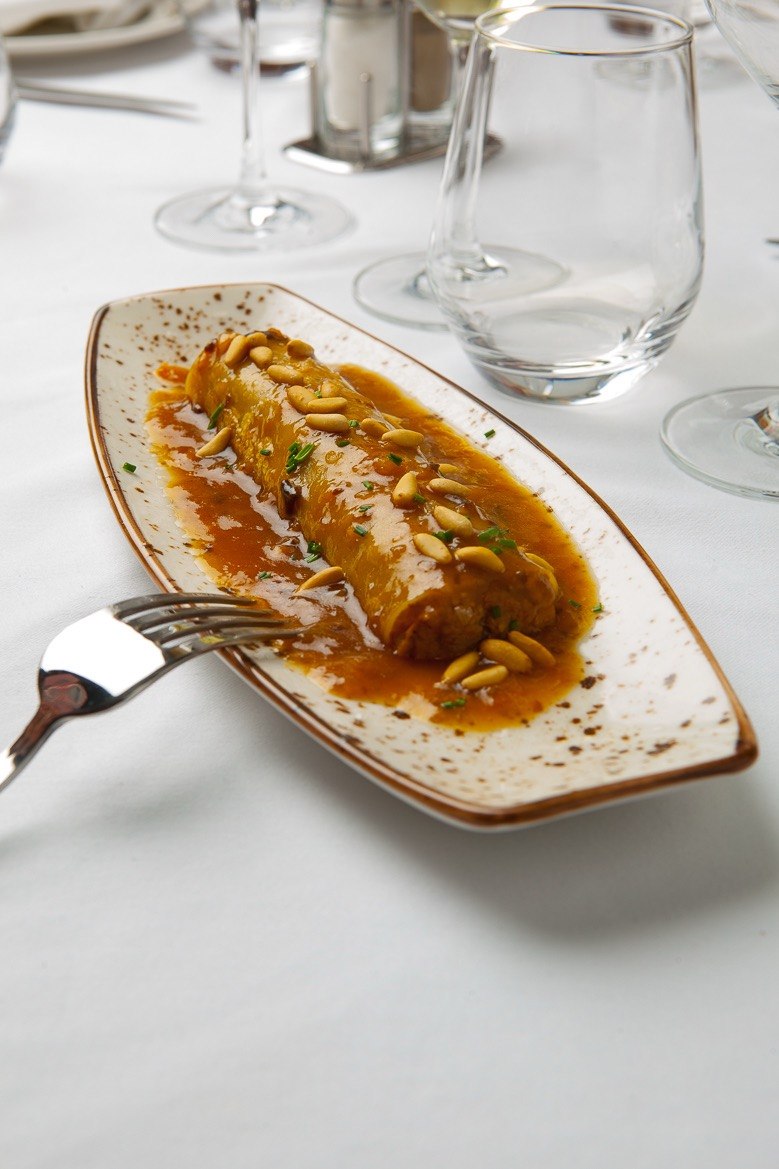
The filling is roast chicken with well-browned onion and a splash of brandy. The sauce is what sets it apart. There is no béchamel: we make it with prunes and dried apricots, slow-cooked onion, chicken stock and a splash of brandy, the same dried fruit that goes with Catalan-style roast chicken. Pine nuts go on top.
€15.00
Contains gluten, egg and pine nuts. If you have an allergy, please tell our staff.
Cannelloni were born in Italy and reached Barcelona in the 19th century with the Italian cooks working in the city. According to the food writer Néstor Luján, they were first served at the Beco del Racó inn, a meeting place for the city’s bourgeoisie. For years they were a treat for well-off households, because the pasta had to be made by hand.
Catalonia made the dish its own: the Italian tomato sauce gave way to béchamel, and the filling came to be made with roasted meat. In the first half of the 20th century, dried pasta from the El Pavo brand took it into every kitchen, and on the morning of St Stephen’s Day (26 December) families gathered to chop the meat left over from Christmas and roll the cannelloni. As the Catalan saying goes, “Sant Esteve, dia de canelons, per conservar tradicions”: St Stephen’s, the day for cannelloni, to keep traditions alive.
The chef Josep Lladonosa sums it up: every house has its own formula. Manuel Vázquez Montalbán, in La cocina de los mediterráneos, gives the classic version, with béchamel and a touch of tomato. Ours is this one: roast chicken, prunes, dried apricots and pine nuts.
To start, try the salt cod fritters (€10.50), and for dessert, the crema catalana (€6.50), with the sugar burnt to order.
Further reading: Àpats, by Alba Sunyer and Clara Antúnez (Parcir Edicions Selectes i Joviat, 2022); Cuina catalana, by Borja Sierra and Òscar Gómez (Montagud Editores); La cuina catalana, by Josep Lladonosa i Giró (Rosa dels Vents, 2022); and La cocina de los mediterráneos, by Manuel Vázquez Montalbán (Ediciones B, 2002).


