
House-made crema catalana, burnt to order and served in an earthenware dish with artisan carquinyolis from La Sénia, at Carrer de la Cera, 49.
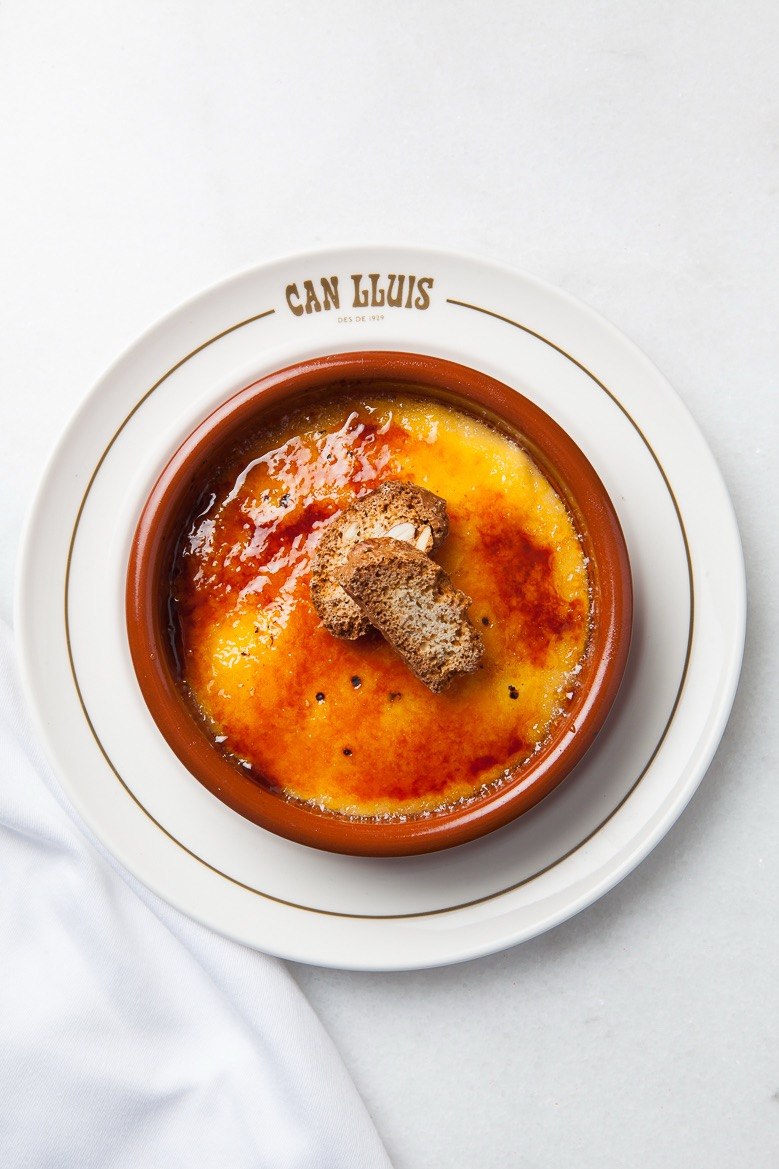
We infuse milk and cream with cinnamon stick and lemon peel, then thicken it with egg yolks only, sugar and a touch of starch over a very low heat. We serve it in an earthenware dish, with the sugar burnt to order so the crust cracks, and with artisan carquinyolis, crisp almond biscuits from La Sénia in the Terres de l’Ebre.
€6.50
Nobody knows exactly where crema catalana began, but it goes back a long way: a Catalan cookbook from the fourteenth century already has milk cooked with eggs. In the eighteenth and nineteenth centuries it was a dessert for feast days in well-off homes, eaten with sponge fingers.
In time it reached every table and became the set dessert for Saint Joseph’s Day, 19 March, which gave it its other name: crema de Sant Josep. The feast falls in the middle of Lent, when households had milk and eggs to spare, and it was the grandmothers who made it and burnt the top with a red-hot iron.
What makes it Catalan is in the detail: yolks only, scented with cinnamon and lemon rather than vanilla, under a crust of burnt sugar that has to be very thin. The pleasure is the contrast: cold underneath, hot and crisp on top. Manuel Vázquez Montalbán said that, faced with what Catalans can do with milk, you have to take your hat off.
Before dessert, try the salt cod fritters (€10.50) or the meatballs with cuttlefish and peas (€16.50).
Further reading: Àpats, by Alba Sunyer and Clara Antúnez (Parcir Edicions Selectes and Joviat, 2022); Cuina catalana, by Borja Sierra and Òscar Gómez (Montagud Editores); and La cocina de los mediterráneos, by Manuel Vázquez Montalbán (Ediciones B, 2002).


